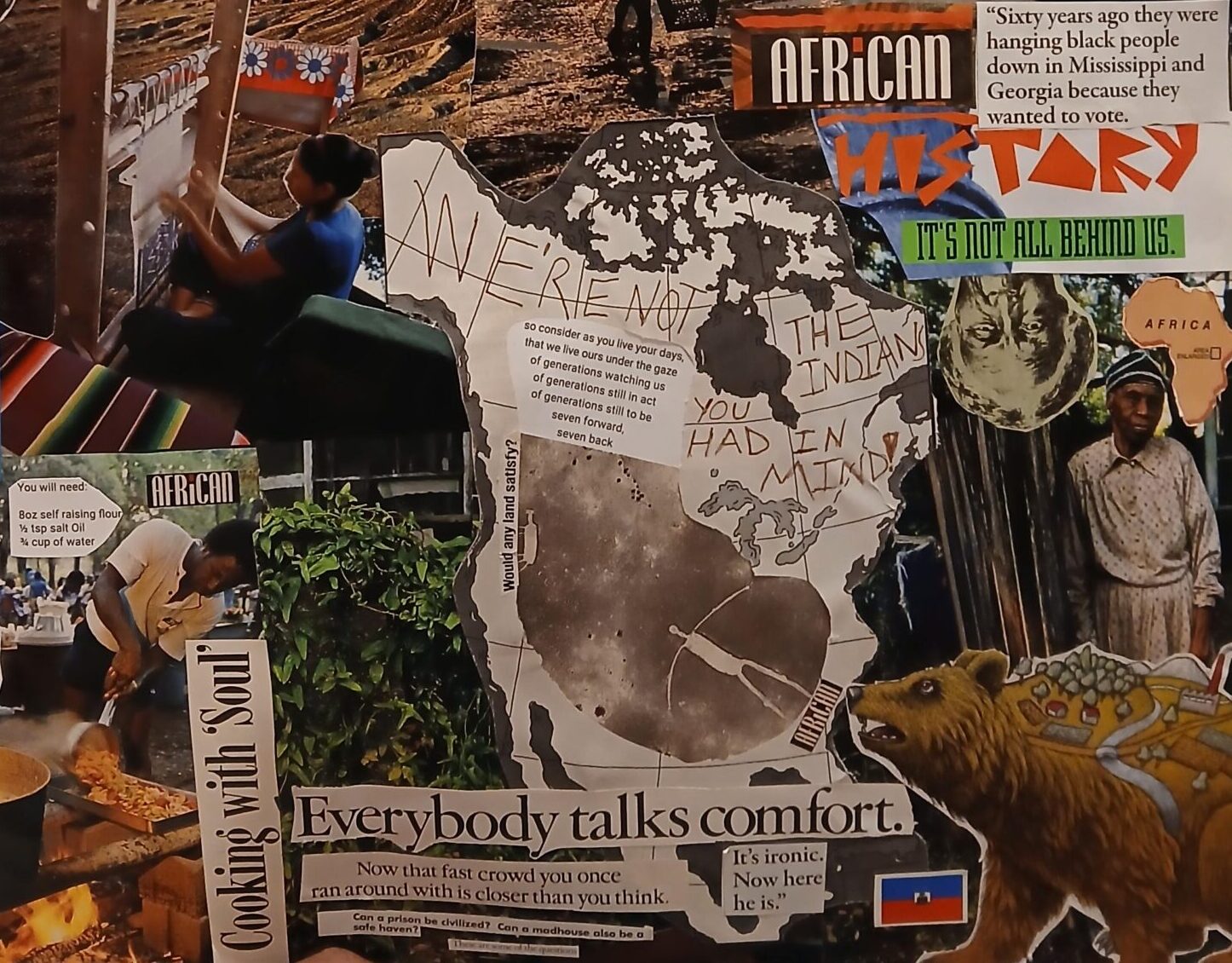
“Education consists not only in the sum of what a [person] knows or the skill with which they can put this to [their] own advantage… [People’s] education must also be measured in terms of the soundness of their judgments of people and things and in [their] power to understand and appreciate the needs of [their] fellow [person], and to be of service to them.”
Kwame Nkrumah – Consciencism
THE PARAMOUNT NECESSITY FOR IDEOLOGICAL TRAINING AND MASS REVOLUTIONARY PRACTICE
“Without revolutionary consciousness there is no Revolution! All those who have had to conduct revolution have been able to verify this. But where does this revolutionary consciousness come from, since it is certain that it is not basic datum; nor does it come into being and develop spontaneously? History teaches that it is created and developed through ideological education and revolutionary practice.
“We can equally affirm that without ideological training and without revolutionary action, there can be no revolutionary consciousness….. 3 “Revolutionary consciousness and revolutionary action or mere Revolution engender and qualify one another forming a dynamic and tense whole with risks of rupture; which when it takes place, becomes fatal to the one and the other.
“History is full of cases where revolutionary action taking the lead on progress in the development of revolutionary consciousness, and thus breaking away from its nourishing source, that is the support and adhesion of the masses, runs into an adventure; accumulates failures and ultimately leads to a result contrary to the one anticipated, the recession on all fronts of the forces of progress, the questioning of all that had already been achieved, the rejection to a remote and uncertain future of every possibility of resuming the struggle.
“On the other hand, there are lots of cases where efforts have been vainly deployed to create and develop certain revolutionary consciousness in view of an action to be undertaken once all the conditions of success have been met. And in each case, all attempts to have a theory of action assimilated outside the field of action itself, be it a humble action because it is the only one possible in the conditions of the movement; have never been carried beyond the halls or clubs of discussion to change any situation whatsoever. On the contrary, they have always been lost in contemplation, in expectation of already missed opportunities, before degenerating definitely into an inactive residuum. “But the case is quite different when ideological training completes, highlights and founds revolutionary action in the process of execution so as to make their objectives understood, and thereby, have the necessary efforts and sacrifices consented.
“No worthwhile revolutionary Party can be mistaken on this today. This effort in training is a permanent problem and the attention which is accorded to it, according to the exigencies; characterize every phase of the Revolution and its leaders.
“The first exigency of the Revolution, the sum total of all other exigencies, is that of new [people] who have freed themselves from the servitudes of love for wealth, men and women who have opted for the general interest, for the People, for a genuine humanism.
“Ideological training, revolutionary ideology is the modern weapon used by the oppressed Peoples to overcome their insufficiencies, to meet the challenge of the powers of exploitation. Revolutionary ideology is the infallible arm that reveals and develops the People’s genius. All revolutionary parties agree on this.
“The work of ideological training in view of the emancipation of a whole People in conditions such as ours is of necessity a long term enterprise. The path to be followed is full of ambushes, the least of which is not the apparent slowness of the results that will crown their efforts.
“It is necessary at the onset to get secured against the risks of discouragement, by acquiring a sufficient amount of patience and perseverance, by taking account of the fact that the results of such an enterprise can only be appreciated on a long term basis, through all the qualitative changes which appear in the behavior of individuals and peoples facing their problems. In these conditions, it is certain that the expected results will only come when 4 the action, which engenders them, continues and this is the second condition of success continuity.
“It is vain and even dangerous indeed to start a work of education and stop it soon afterwards. Besides the fact that no result will be obtained, no worthwhile lesson will be drawn from it, the future is likely to be compromised by the doubt that will get hold of the militants as regards the determination and the competence of the leaders to keep to their promise and to carry on an action that was freely undertaken and presented in the beginning as absolutely indispensable.
“This action must be carried on obstinately, without intermission, with, of course, the necessary adaptation of the methods to all the new data.”
excerpted from Ahmed Seku Ture’s “FORWARD”, in the STRATEGY AND TACTICS OF THE REVOLUTION